


 |
Thank you for your interest in our research activities. The research of the group is focused on development of new selective synthetic transformations. The main area is catalysis for organic synthesis including both transition metal and organocatalysis. The main methodology involves functional group transformations and C-H functionalization methods. Currently, the most important synthetic targets are organoboronates and organofluorine compounds. A selection of the most recent projects are summarized below. |
| Keywords:Homogenous catalysis, Metal catalysis (Pd, Cu, Rh, Ir, Zn, Ag), Organocatalysis (BINOLs, hypervalent iodines), Asymmetric catalysis (allylation, homologation and fluorination reactions), Organoboron chemistry, Allylboronic acids, Organofluorine chemistry, Oxyfluorination, Iodofluorination, Difluorination, Trifluoromethylation, 18F labelling for PET, Fluoro-iodoxoles. |
| Synthesis and application of organoboronates |
| Asymmetric homologation of organoboronates. The homologation reaction was extended to synthesis of chiral propargyl boronate species. These are synthethically very useful compounds but very unstable species. Thus, we combined the homologation reactions with in situ propargylboroation of ketones. This process is suitable for synthesis of chiral allenols with remarkably high selectivity and with broad synthetic scope. |
 |
| We explored the synthetic utility of the chiral allylboron compounds for synthesis of densely functionalized β-fluorohydrins with tertiary fluoride stereocenters. |
 |
| Chiral allylboronates (prepared by the homologation method below) proved to be suitable substrate for Se-catalyzed electrophilic sulfenofunctionalization reactions. The procedure is stereoselective and thus suitable for synthesis of a wide range of chiral di- and trifluoromethylthiolate, thiocyanates. |
 |
| In 2020, we have developed an organocatalytic reaction based on homologation of vinylboronic acids/boroxines with trifluoromethyl diazometanes (see cover above). The method was suitable for synthesis of chiral α-trifluoromethyl allylboronic acids with excellent ee. These chiral allylboronic acids react with full chirality transfer in oxidation and allylboration reactions. The homologation procedure was subsequently extended to alkyl and aryl boronates as well. A comprehensiv DFT modeling study on the mechanism of the asymmetric homologation was published recently. |
 |
Synthesis and application of allylboronic acids. The group has developed several efficient methods for synthesis of allylboronates from allyl alcohols and diboronates as boron source a good overview of this work (by 2016) is summarized in a JACS Perspective). |
 |
We developed a palladium-catalyzed synthesis of racemic allylboronic acids from allylic alcohols. |
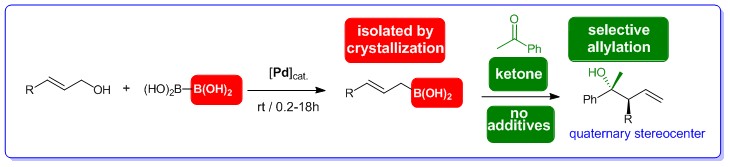 |
| Surprisingly, the isolated allylboronic acids readily react with ketones, imines and hydrazones in a "self-catalyzed" process without any additives. Using commercially available chiral organocatalysts (BINOL derivatives) asymmetric allylation reactions can be performed. In case of application of 3,3'-disubstituted allylboronic acids (geranyl or neryl boronic acids) with ketones homoallylic alcohols bearing adjacent quaternary stereocenters could be obtained with excellent stereo and enantioselectivity. |
 |
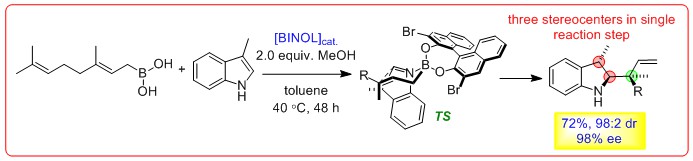
| The allylation reaction could also be employed for functionalisation of indoles and dihydro-isoquinolines.In case of skatol three stereocenters could be created with high selectivity in a single step. |
 |
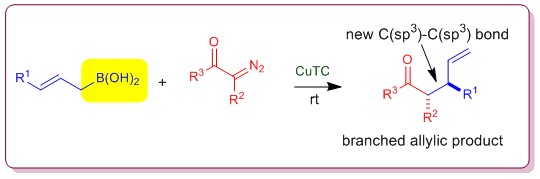
| Allylboronic acids undergo cross-coupling reaction with diazo-ketones. In case of Cu-catalyzed reaction the branched allylic product is formed, while using Pd-catalysis the corresponding linear products are formed. |
 |
| We have found that allenylboronic acids (similarly to allylboronic acids) are much more reactive than their Bpin counterparts. Therefore, we have developed an efficient synthesis for allenylboronic acids based on Cu-catalyzed borylation of propargyl carbonates. Allenyl boronic acids are also excellent substrates for asymmetric propargylation, in particular for synthesis of sterically encumbered homopropargylic alcohols and amino-acids. |
 |
| Fluorination, trifluoromethylation and trifluoromethylthiolation reactions (introduction of F, CF3, SCF3 groups) |
| Catalytic asymmetric fluorination. The group has a vivid researach program on development of new fluorination methods. In these procedures, safe non-toxic fluorinating reagents are employed for selective introduction of the fluorine atom in various organic molecules. Recently, we have developed an organocatalytic method for synthesis of heterocycles with tertiary C-F centers. This method is based on application of chiral iodo resorcinol catalysts, which are converted to hypervalent iodo fluorines in situ. The mechanism and the enantioselection step was studied by DFT modeling. |
 |
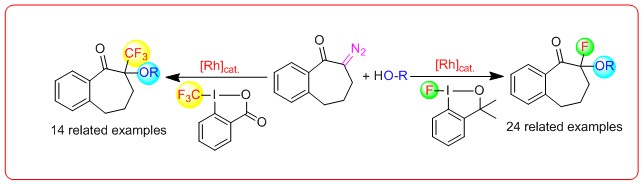
| Electrophilic fluorination, trifluormethilation and trifluoromethylthiolation. The group have developed a number of useful fluorination and trifluoromethylation based difunctionalization reactions. For example, rhodium catalyzed geminal oxyfluorination and trifluoromethylation was developed using diazoketone substrates.This process was extended even for trifloromethylthiolation reactions as well. |
 |
 |
| A logical extension of the above reaction is a trifluoromethylthiolation based C-C bond formation reaction. This could be achieved using electrophilic SCF3 transfer reagent together with various hypervalent boron compounds. The mechanistic studies indicate a Hooz type reaction. |
 |
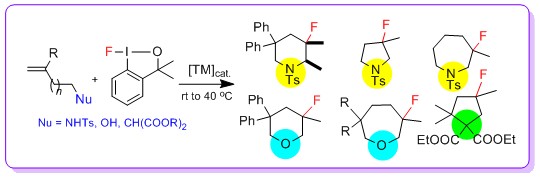
| A number of fluorocyclization reactions have been developed using electrophilic fluorobenzoiodoxole derivatives. In a collaborative study with the Himo-group (Stockholm University), we have also investigated the detailed mechanism of the aminofluorination process. |
 |
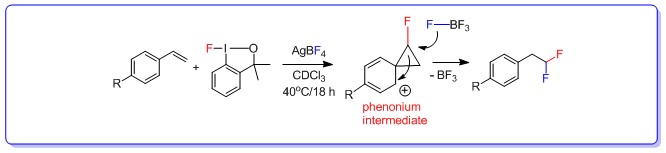
We have also presented an effecient difluorination method, which proceeds via phenonium intermediate. |
 |
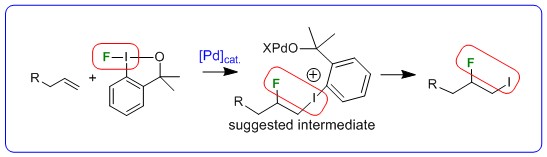
| When this reaction was performed using Pd-catalyst an interesting iodofluorination reaction occured. |
 |
| Cyclopropane derivatives undego electrophilic ring opening in the presence flouroidines affording 1,3-difluorination or 1,3-oxyfluorination reactions. |
 |
| New methodology for fluorine-18 labelling |
| One of the activities of the Szabó group involves development of new catalytic fluorination methods for life sciences. The main goal is to translate recently reported fluorination methods for synthesis of fluorine-18 labelled tracers for Positron Emission tomography (PET). |
| Labelling of nitrogen containing aryl derivatives.. Nitrogen and fluorine occur simoultaneuosly in many drug substances. The late stage fluorine-18 labelling is often complicated by the presence of nitrogen containing functional groups in the molecules, in particularly for metal mediated reactions. Our target molecule was melflufen, an anti-cancer drug with three nitrogen containing groups including the bis(2-chloroethyl)amino pharmacophore. The fluorine-18 labelling was achieved by copper-mediated radiofluorination in the presence of nitrogen containing ligands. |
 |
We have studied the possibilities for conversion of a -COCF3 functional group to a difluoro enol silyl ether followed by halogenation and fluorine-18 labelling. The utility of this method was demonstrated by the synthesis of fluorine-18 labelled neutrophil elastase inhibitors. |
 |
| Electrophilic fluorine-18 labelling. An important methodology is fluorine-18 labelling of organic molecules. We suceeded to develop a radiosynthetic procedure for preparation of [18F]fluorobenziodoxole, which is a priviledged electrophilic fluorination reagent (see above). The radiosynthesis could be achived from easily accessible [18F]TBAF reagent, which contains a nucleophilic fluorine anion. The new reagent was used for electrophilic fluorocyclization of styril-amides. |
 |
Application of of [18F]fluorobenziodoxole was also extended to bifunctionalization of diazocarbonyl compounds. By this rhodium-catalysed procedure (see above the version with the natural isotope) the fluorine-18 labelling was coupled with introduction of a methoxy group. The labelling reaction proceeds with a high level of high molar activity. |
 |
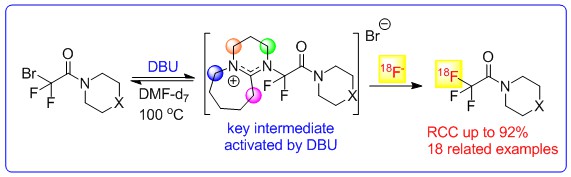
| In collaboration with the Schou group (Karolinska Institutet) we succeeded to develop a new methodology for radiosynthesis of 18F-labelled trifluoroacetamides. We have found that DBU acts as a nucleophilic organomediator in the key [18F] substitution step of this process. |
 |