
The field of biocatalysis, where enzymes are utilized, has attracted considerable attention and has become a fast growing research area in selective organic synthesis. Attractive properties of enzymes are their high substrate specificity, high enantioselectivity, and high activity in mild reaction conditions. If higher reaction temperatures have to be used, thermal stability is of the essence.
In order to improve the enzyme performance in the reaction, optimization of the reaction conditions is an option but if further optimization is not sufficient, the only powerful approach is to modify the enzyme. The process of iteratively mutate the enzyme and selecting for desired traits is called directed evolution.
Among the lipases that are the currently under investigation in professor Bäckvalls group are lipase A and B (CalA and CalB) from the yeast Candida antarctica. While CalB has been far more frequently used in these chemoenzymatic reactions, the highly thermostable CalA has received much less attention. Research is currently focused on both Candida antarctica lipase A and B.
We have in collaboration with a crystallographic group in Uppsala published a crystal structure of the CalA protein.
We have also outlined the mechanistic workings of this enzyme by site-directed mutagenesis, followed by kinetic studies and molecular dynamics simulations.
One of the main goals of the project has been the development of increased enantioselectivity in of Candida Antarctica Lipase A towards chiral α-methyl acids. This is achieved through semi-rational redesign where the introduction of random mutations in the gene at specific sites of the enzyme. We have produced mutant libraries of CalA in the yeast P. Pastoris. Several enantioselective enzyme variants towards α-methyl acids have been found.
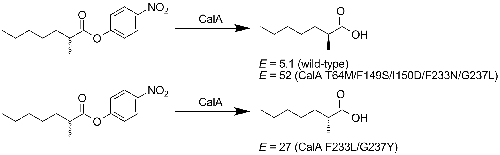 Scheme 11. Enantioselective hydrolysis of α-methyl acids using a mutated version of CalA