
I) Organopalladium chemistry
Some early contributions by the group on transition metal-catalyzed reactions involved mechanistic studies of specific organometallic steps involved in catalytic transformations. One example is the mechanistic study of the industrially important Wacker process, a large-scale industrial process for the production of acetaldehyde from ethylene. In 1979 the Bäckvall group reported on a stereochemical study, using deuterated ethene, which showed that the reaction occurs via trans-hydroxypalladation. The paper led to a new understanding of the mechanism of the process and the results have become textbook material.
In a series of papers the group has studied the mechanism of palladium-catalyzed reactions. These studies have included determination of the stereochemistry of nucleophilic attack on π-olefin and π-allylpalladium complexes, oxidative cleavage of palladium-carbon bonds. An important contribution was the demonstration that the acetate anion can attack the π-allylpalladium complexes either from the same face (cis) or from the opposite face (trans) to the metal. This was used in catalytic reactions to obtain either 1,4-cis or 1,4-trans-diacetoxylation products of 1,3-dienes. This controlled duality in the stereochemistry is of synthetic interest. The catalytic reactions were extended to the development of a range of stereoselective palladium-catalyzed 1,4-oxidations of conjugated dienes.
Of these catalytic reactions the cis-1,4-chloroacetoxylation has become the most synthetically important. The synthetic use of the chloroacetoxylation reaction is enhanced by the fact that the chloride and acetate can be substituted by various nucleophiles in a sequential manner and with high stereoselectivity (also with dual stereocontrol). In this way a large number of stereodefined 1,4-functionalized products of 1,3-dienes have been prepared and used in natural product synthesis.
The group has more recently developed novel palladium-catalyzed oxidative carbocyclizations involving conjugated dienes, allenes, and alkenes. These reactions proceed via an activation of the allene, which can be envisaged as a nucleophilic attack by the allene on Pd(II) leading to a vinyl-Pd species (Scheme 1).
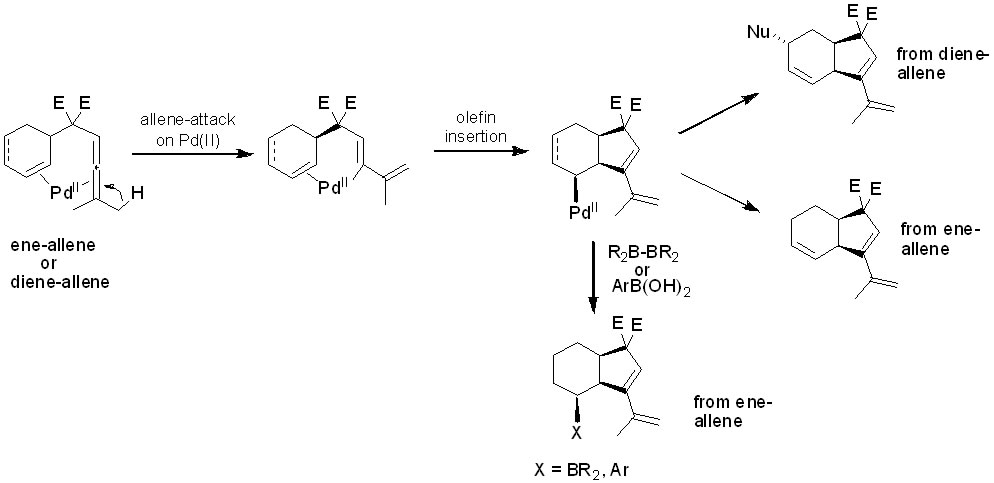 Scheme 1. Palladium-catalyzed oxidative carbocyclizations
Deuterium labeling has confirmed the mechanism depicted in Scheme 1. Furthermore, in previous studies we have shown that the allene can act as a p-nucleophile on a (p-allyl)palladium complex attacking the allyl ligand on the opposite face to that of palladium (trans attack). This shows that the middle carbon of the allene is nucleophilic. Recently it was also shown that the palladium-carbon bond in the intermediate from the ene-allene can be cleaved with a diborane or an arylboronic acid to give a catalytic 1,2-carboboration or 1,2-carboarylation. It was shown that the overall 1,2-carboboration and 1,2-carboarylation of the olefin occur with cis stereochemistry, which is consistent with a cis-carbopalladation followed by cleavage of the palladium-carbon bond by with retention of configuration at carbon.
II) Ruthenium-catalyzed reactions
Bäckvall and coworkers have also made important contributions to metal-catalyzed hydrogen transfer reactions. In 1991 the base effect in ruthenium-catalyzed hydrogen transfer leading to a rate acceleration of 103-104 was reported. This had a significant impact on the development of ruthenium-catalyzed hydrogen transfer reactions. More recently the work has focused on the mechanisms, and this work has been fruitful for the development of biomimetic oxidations and for the combination of metals and enzymes (vide supra).
Cyclopentadienyl ruthenium dicarbonyl catalyst 1 was developed in our group and has been utilized for racemization of secondary alcohols. This racemization has also been integrated with enzymatic resolution leading to numerous examples of dynamic kinetic resolution (DKR) of secondary alcohols, producing esters with high optical purity and in high yields. Extensive experimental and theoretical research on the mechanism for racemization of secondary alcohols with ruthenium catalyst 1 has led to a significantly increased understanding of (transfer) hydrogenation reactions.
Ruthenium catalyst 1 has been found to efficiently affect full racemization within 10 minutes at ambient temperature and with only 1 mol% catalyst loading. The mechanism (Scheme 2) begins with activation of the precatalyst 1 by t-BuOK, forming ruthenium tert-butoxide complex 2 (Scheme 2, step i), which has been characterized by 1H and 13C NMR. The activation of catalyst 1 is instantaneous and clearly visualized by a color change from yellow to red. Experimental support for complex 2 as an active intermediate in the catalytic cycle was found by the immediate racemization of (S)-3 upon addition to complex 2. Subsequent alcohol-alkoxide exchange produces ruthenium sec-alkoxide complex 4 (Scheme 2, step ii), which has been characterized by 13C NMR.
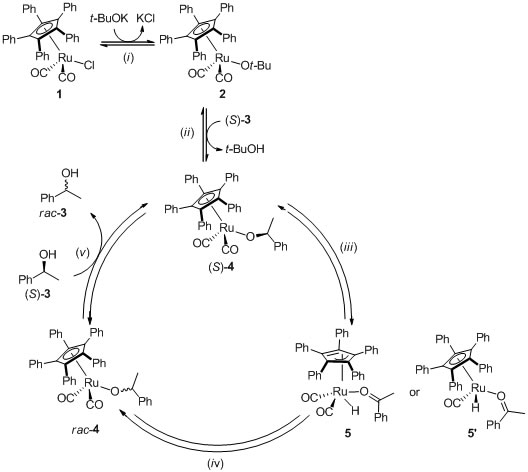 Scheme 2. Proposed racemization mechnism of secondary alcohols with ruthenium catalyst 1.
Racemization proceeds via an inner-sphere mechanism, ruling out participation of a free ruthenium hydride species. Since complex 4 is a coordinatively saturated 18 electron species, racemization via β-hydride elimination requires a free coordination site on ruthenium. This free coordination site could be formed either via η5 → η3 ring slippage forming complex 5 or by dissociation of a CO ligand forming complex 5’ (Scheme 2, step iii). Initially the η3-ketohydride intermediate 5 was proposed, but recent computational studies favored CO dissociation. More recent results from mechanistic studies have provided strong experimental support for reversible CO dissociation as a key step in the racemization mechanism.
In the next step of the catalytic cycle, readdition of the hydride to either side of the prochiral ketone produces the racemic alcohol (Scheme 2, step iv). The racemic substrate is released by another alcohol-alkoxide exchange, thus completing the catalytic cycle (Scheme 2, step v).